Thursday, November 19, 2009

Time-unrestricted Takbir from the beginning of Dhul-Hijjah

Fatwa no. 10777

Q: I hear some people reciting Takbir (saying: "Allahu Akbar [Allah is the Greatest]") after each Salah (Prayer) during the Days of Tashriq (11th, 12th and 13th of Dhul-Hijjah) until the ‘Asr (Afternoon) Prayer of the third day. Is this correct or not?

A: It is prescribed to recite an unrestricted [in terms of time. Ed] or a restricted Takbir during ‘Eid-ul-Adha (the Festival of the Sacrifice). The unrestricted Takbir can be recited at any time from the beginning of Dhul-Hijjah until the last Day of Tashriq. The restricted Takbir should be recited after the Obligatory Daily Prayers starting from the Fajr (Dawn) Prayer of the Day of ‘Arafah until the ‘Asr Prayer on the last Day of Tashriq. The evidence for the permissibility of doing this is the Ijma‘ (consensus of scholars) and the practice of the Sahabah (Companions of the Prophet, may Allah be pleased with them).

May Allah grant us success! May peace and blessings be upon our Prophet Muhammad, his family, and Companions!


Permanent Committee for Scholarly Research and Ifta’

Member
Committee Deputy Chairman
The Chairman
`Abdullah ibn Ghudayyan
`Abdul-Razzaq `Afify
`Abdul-`Aziz ibn `Abdullah ibn Baz 

taken from: http://alifta.com/Fatawa/FatawaChapters.aspx?View=Page&PageID=124&PageNo=1&BookID=10


Wednesday, November 18, 2009

Virtue of the first ten days of Dhul-Hijjah

At- Tawabah (repentance)
Sincere repentance is obligatory on Muslims every time. It is more likely to be accepted by Allah during these virtuous days. So we must hasten to repent our sins and mend our ways for good in the blessed period.
 
Sincere repentance. 

One of the most important things to do during these ten days is to repent sincerely to Allaah and to give up all kinds of disobedience and sin. Repentance means coming back to Allaah and foregoing all the deeds, open and secret, that He dislikes, out of regret for what has passed, giving it up immediately and being determined never to return to it, but to adhere firmly to the Truth by doing what Allaah loves.

If a Muslim commits a sin, he must hasten to repent at once, without delay, firstly because he does not know when he will die, and secondly because one evil deed leads to another.

Repentance at special times is very important because in most cases people’s thoughts turn towards worship at these times, and they are keen to do good, which leads to them recognizing their sins and feeling regret for the past. Repentance is obligatory at all times, but when the Muslim combines sincere repentance with good deeds during the days of most virtue, this is a sign of success, in sha Allaah. Allaah says (interpretation of the meaning): "But as for him who repented, believed and did righteous deeds, then he will be among those who are successful." [al-Qasas 28:67]

The Muslim should make sure that he does not miss any of these important occasion, because time is passing quickly. Let him prepare himself by doing good deeds which will bring him reward when he is most in need of it, for no matter how much reward he earns, he will find it is less than he needs; the time of departure is at hand, the journey is frightening, delusions are widespread, and the road is long, but Allaah is ever watchful, and to Him will we return and render account. As the Qur’aan says (interpretation of the meaning):

"So whosoever does good equal to the weight of an atom, shall see it,

And whosoever does evil equal to the weight of an atom, shall see it."

[al-Zalzalah 99:7-8]

There is much to be gained, so make the most of the opportunity afforded by these invaluable and irreplaceable ten days. Hasten to do good works, before death strikes, before one can regret one’s negligence and failure to act, before one is asked to return to a place where no prayers will be answered, before death intervenes between the hopeful one and the things he hopes for, before you are trapped with your deeds in the grave.

O you whose hard heart is as dark as the night, is it not time that your heart was filled with light and became soft? Expose yourself to the gentle breeze of your Lord’s mercy during these ten days, for Allaah will cause this breeze to touch whomever He wills, and whoever is touched by it will be happy on the Day of Judgement. May Allaah bless our Prophet Muhammad and all his Family and Companions. 

Doing more good deeds generally
Doing more good deeds during this period will attract greater reward from Allah. We should therefore seize the opportunity to perfect our obligatory prayers and offer more superogatory ones, read the Qur’an the more, engage in more adhkar, make more supplications (du’aa’), give in charity, honour our parents, uphold the ties of kinship, and enjoin what is good and forbid what is evil, among other good deeds and acts of worship.

May Allah make it easy for us to reap all the benefits of the blessed days. Amin!


A Sin that Leads to Jannah…

Ibn al-Qayyim (rahimahullah) said:
 
"Sin may be more beneficial for a person, if it leads him to repent, than doing a lot of acts of worship. This is what is meant by the words of one of the salaf:
'A person may commit a sin and enter Paradise because of it, or he may do an act of worship and enter Hell because of it.'
They said: 'How is that?'

He said: 'He may commit a sin and continues to think about it, and when he stands or sits or walks he remembers his sin, so he feels ashamed and repents and seeks forgiveness and regrets it, so that will be the means of his salvation.
 
And he may do a good deed and continue to think about it, and when he stands or sits or walks he remembers it and it fills him with self-admiration and pride, so it is the cause of his doom.
 
So the sin may be the factor that leads him to do acts of worship and good deeds and to change his attitude so that he fears Allah and feels shy before Him and feels humiliated before Him, hanging his head in shame and weeping with regret, seeking he forgiveness of his Lord. Each of these effects is better for a person than an act of worship that makes him feel proud and show off and look down on people. Undoubtedly this sin is better before Allah and is more likely to bring salvation than one who admires himself and looks down on others, and who thinks that he is doing Allah a favour. Even if he says words that indicate something other than that, Allah is the Witness over what is in his heart. Such a person may feel hatred towards people if they do not hold him in high esteem and humiliate themselves before him. If he were to examine himself honestly, he would see that clearly."

-Madarij as-Salikeen, 1/299

Stories of non-human living beings that loved Muhammad (Sallalahu Alahi wa Sallam)


DatePalm Tree:


Narrated Jabir bin 'Abdullah radi Allahu anhu:The Prophet sal Allahu alayhi wa sallam used to stand by a tree or a date-palm on Friday. Then an Ansari woman or man said. "O Allah's Apostle! Shall we make a pulpit for you?" He replied, "If you wish." So they made a pulpit for him and when it was Friday, he proceeded towards the pulpit (for delivering the sermon). The date-palm cried like a child! The Prophet descended (the pulpit) and embraced it while it continued moaning like a child being quietened. The Prophet said, "It was crying for (missing) what it used to hear of religious knowledge given near to it."

Ibn Umar radi Allahu anhuma narrated: The Prophet sal Allahu alayhi wa sallam used to deliver his sermons while standing beside a trunk of a datepalm. When he had the pulpit made, he used it instead. The trunk started crying and the Prophet went to it, rubbing his hand over it (to stop its crying).


Narrated Jabir bin 'Abdullah: The Prophet sal Allahu alayhi wa sallam used to stand by a stem of a date-palm tree (while delivering a sermon). When the pulpit was placed for him we heard that stem crying like a pregnant she-camel till the Prophet got down from the pulpit and placed his hand over it.

These ahadeeth are classified as mutawaatir, meaning so many sahaba narrated it that it cannot be fabricated. The different narrations show that they all witnessed it in the masjid. This is a miracle of the Prophet sal Allahu alayhi wa sallam, and the narrations of the sahaba are all authentic, found in Bukhari and Muslim. This tree trunk, which seems like a lifeless being to us, is actually alive and was so affected by the Prophet sal Allahu alayhi wa sallam.

[Read More :Miracle of the Crying of the Tree Trunk Regarding the Remembrance of Allah - DarusSalam. Extracted from the book "Miracles of the Messenger (S)" published by dar-us-salam.com]

Mount Uhud 

Narrated Anas radi Allahu anhu: Allah's Apostle sal Allahu alayhi wa sallam ascended the (mountain) of Uhud with Abu Bakr and 'Uthman and it shook. Allah's Apostle said, "Be calm, O Uhud!" I think he stroked it with his foot and added, "There is none on you but a Prophet, a Siddiq and two martyrs." (Sahih Bukhari)

The Prophet sal Allahu alayhi wa sallam was traveling one time: "and when Uhud was within sight, he said: This is the mountain which loves us and we love it." (Sahih Muslim)

This is a mountain, made up of rocks and stones, yet we are made of flesh and have been given hearts that beat...do we love the Prophet sal Allahu alayhi wa sallam as this mountain? Do we shake like this mountain out of love for him?


A Stone
Jabir b. Samura reported Allah's Messenger (may peace be upon him) as saying: I recognise the stone in Mecca which used to pay me salutations before my advent as a Prophet and I recognise that even now. (Sahih Muslim: Book 030, Number 5654: )

How often do we salute/send salawaat on the Prophet sal Allahu alayhi wa sallam? The Prophet knew this stone, and if we send salawaat on him, especially on Fridays, they will be presented to him from us.

Wait for the Brick


A young and successful executive was traveling down a neighborhood street, going a bit too fast in his new Jaguar. He was watching for kids darting out from between parked cars and slowed down when he thought he saw something. As his car passed, no children appeared. Instead, a brick smashed into the Jag's side door! He slammed on the brakes and drove the Jag back to the spot where the brick had been thrown. The angry driver then jumped out of the car, grabbed the nearest kid and pushed him up against a parked car, shouting, "What was that all about and who are you?

Just what the heck are you doing?

That's a new car and that brick you threw is going to cost a lot of money.

Why did you do it?"

The young boy was apologetic. "Please mister … please, I'm sorry… I didn't know what else to do," he pleaded.

"I threw the brick because no one else would stop…"

With tears dripping down his face and off his chin, the youth pointed to a spot just around a parked car.
"It's my brother," he said.

"He rolled off the curb and fell out of his wheelchair and I can't lift him up."

Now sobbing, the boy asked the stunned executive, "Would you please help me get him back into his wheelchair? He's hurt and he's too heavy for me."

Moved beyond words, the driver tried to swallow the rapidly swelling lump in his throat. He hurriedly lifted the handicapped boy back into the wheelchair, then took out his fancy handkerchief and dabbed at the fresh scrapes and cuts. A quick look told him everything was going to be okay.

"Thank you and may God bless you," the grateful child told the stranger.

Too shook up for words, the man simply watched the little boy push his wheelchair-bound brother down the sidewalk toward their home. It was a long, slow walk back to the Jaguar. The damage was very noticeable, but the driver never bothered to repair the dented side door. He kept the dent there to remind him of this message: Don't go through life so fast that someone has to throw a brick at you to get your attention!
God whispers in our souls and speaks to our hearts. Sometimes when we don't have time to listen, He has to throw a brick at us.

It's our choice: Listen to the whisper … or wait for the brick!

The Wooden Bowl


A frail old man went to live with his son, daughter-in-law, and a four-year old grandson. The old man's hands trembled, his eyesight was blurred, and his step faltered. The family ate together nightly at the dinner table. But the elderly grandfather's shaky hands and failing sight made eating rather difficult.

Peas rolled off his spoon onto the floor. When he grasped the glass often milk spilled on the tablecloth. The son and daughter-in-law became irritated with the mess. "We must do something about grandfather," said the son. I've had enough of his spilled milk, noisy eating, and food on the floor. So the husband and wife set a small table in the corner. There, grandfather ate alone while the rest of the family enjoyed dinner at the dinner table.

Since grandfather had broken a dish or two, his food was served in a wooden bowl. Sometimes when the family glanced in grandfather's direction, he had a tear in his eye as he ate alone. Still, the only words the couple had for him were sharp admonitions when he dropped a fork or spilled food. The four-year-old watched it all in silence.

One evening before supper, the father noticed his son playing with wood scraps on the floor. He asked the child sweetly, "What are you making?" Just as sweetly, the boy responded, "Oh, I am making a little bowl for you and mama to eat your food from when I grow up." The four-year-old smiled and went back to work. The words so struck the parents that they were speechless. Then tears started to stream down their cheeks. Though no word was spoken, both knew what must be done. That evening the husband took grandfather's hand and gently led him back to the family table.

For the remainder of his days he ate every meal with the family. And for some reason, neither husband nor wife seemed to care any longer when a fork was dropped, milk spilled, or the tablecloth soiled. Children are remarkably perceptive. Their eyes ever observe, their ears ever listen, and their minds ever process the messages they absorb. If they see us patiently provide a happy home atmosphere for family members, they will imitate that attitude for the rest of their lives. The wise parent realizes that every day that building blocks are being laid for the child's future.

Let us all be wise builders and role models. Take care of yourself, … and those you love, … today, and everyday!

"And We have enjoined on man
to be good and dutiful to his parents"
[Soorah al-Ankaboot (29): 8]

"And your Lord has decreed (commanded) that you worship none but Him. And that you be dutiful to your parents..." [Soorah al-Isra (17): 23]


"The Lord is pleased with the pleasing of the parents, and the Lord is angry with him who angers the parents." [Saheeh al-Jamee (3500) ]

Takbeer of these days [1st to 13th of dhul hijjah]

asalamualikum.

Someone asked that in eid al-adha the people make tabkeer and praise in loud voice in masajid, is it permissible?

Shaykh Responded by saying: this is sunnah. [then shaykh told about Takbeer of Eid al-fitr] accordingly, in Eid-Adha takbeer is sunnah in the first 10 days from the entrance of the month, from the first night of month of Dhul-Hijjah to night of the eid to day of the eid to day of the Tashreek, 13 days all of it takbeer in the month of the Dhul-Hijjah, the the first of the month to the sunset of 13th day, all of it takbeer, but in the day of Arafah and what is after it consists of limited and general takbeer, make limited takbeer after the five salawat and make takbeer for rest of the time, the muslim and muslimah, men and women after salat al-fajr from day of Arafah and day of Eid and days of the Tashreek at the end of salawat and rest of the period, meaning the rest of the day and night.


http://ourtranslations.blogspot.com/2009/10/someone-asked-that-in-eid-al-adha.html


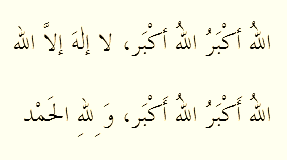
The Takbîr for ‘Eid

Ibn Mas’ûd – Allâh be pleased with him – used to say the takbîr during the Days of Tashrîq thus:
eid-takbeer
Allâh is Greatest, Allâh is Greatest, none deserves worship but Allâh. Allâh is Greatest, Allâh is Greatest, and to Him is all praise.

From The Greatest Causes of Fitnah

From The Greatest Causes of Fitnah
Shaykh-ul Islaam Ibn Taymiyyah

Ibn Muflih said in "al-Fur'oo : 6/160-161" :

Our shaykh [Meaning Ibn Taymiyyah] said :

The general of the trials and tribulations (fitna) which have occured : the greatest of their reason is a decrease of Patience.

And as such : Fitna has two reasons:
1. Weakness of knowledge or
2. Weakness of Patience

Indeed ignorance and transgression are the causes of evil.

And the doer of evil; he will do it due to :
- his ignorance that the actions is indeed evil [and harmful]
- Or due to the fact that his soul wants to do that.

Therefore, by Knowledge ; ignorance ceases , and by Patience; he can hold back the desires.

And thus the fitna will end.

Shaykh-ul Islaam Ibn Taymiyyah


Source : http://www.almosleh.com/almosleh/article_1263.shtml
Translation by : Abu Waheeda as-Salafee

al-Mahabbah (Love of Allaah)

al-Mahabbah (Love of Allaah)

People have discussed about mahabbah (love of Allaah); its causes and what brings it about, its signs, its fruits, and its rulings. The most comprehensive saying about this is what Abu Bakr al-Kattaanee (d.322H) relates about al-Junayd (d.297H).

Abu Bakr al-Kattaanee (d.322H) said: “A discussion about mahabbah took place in Makkah during the Pilgrimage month. The Shaykh’s who were present spoke about this matter, and al-Junayd was the youngest of them. They said to him: ‘O ‘Iraqi, what do you have to say?’ So he bowed his head and tears were flowing from his eyes, then he said:

‘A servant should overcome his soul;
And be continuous in the remembrance of his Lord;
Establishing the rights of his Lord;
Focusing upon Him with his heart;
The light of fear letting ablaze his heart;
Whilst drinking from the vessel of true love;
And certain realities become unveiled for him.
So when he talks, it is due to Allaah.
When he speaks, it is from Allaah.
When he moves, it is by the Command of Allaah.
And when he is serene, then it is from Allaah.
He belongs to Allaah, is for Allaah, and is with Allaah.’
So the Shaykh’s started to weep and said: ‘How can that be increased upon. May Allaah reward you with good, O crown of the knowledgeable ones!’.”

Taken from: Madaarij-us-Saalikeen, 3/9 (of Imaam ibn Qayyim)

Ibn al-Qayyim: Patience Preserves the Health of Hearts and Bodies

Ibn al-Qayyim: Patience Preserves the Health of Hearts and Bodies
Filed under: General
Tuesday, June 09 2009 - by SoundHealth
Key topics: Patience

Mail to a FriendPrinter friendly

Ibn al-Qayyim said in The Prophetic medicine regarding patience:
Patience is half of faith; for this is a quality composed of patience and gratitude (shukr). As one of the ancestors (salaf) has said: Faith is in two halves: one half patience, one half gratitude. And the Most High said: Indeed in that there are signs for each one who is patiently persevering and truly grateful [Surah Ibrahim: 5]. Patience in relation to faith is like the head in relation to the body. It is of three types:

  • (1) patience concerning the obligations (fard) laid down by Allah, that one should not neglect them;
  • (2) patience in abstaining from actions forbidden by Him, that one should not commit them;
  • (3) patience concerning His judgments (qada') and decrees (qadar), that one should not resent them.
Whoever perfectly fulfills these three degrees has perfected patience. For the pleasure of this world and the next, their blessings, and victory and conquest can only be reached over the bridge of patience, just as no-one reaches Paradise except by crossing over the Path. 'Umar b. al-Khattab said: We attained the best of life through patience.

If you reflect on the degrees of perfection acquired in the world, you will see that they are all dependent on patience. And if you reflect on imperfection, which one is blamed for possessing, you will see it all stemming from lack of patience. Thus courage and purity, goodness and love of others, all this is the patience of an hour.

Most sicknesses of the body and heart arise simply from lack of patience. And there is naught like patience for preserving the health of hearts, bodies and spirits. For it is the great remedy, the mighty tiryaq, even if it were to contain only the company of Allah "for Allah is with the patient" [Surah Al-Baqarah:153], and His affection for them for indeed "Allah loves those who are patient"[Surah Al-Imran:146], and His giving victory to His people 'for victory comes with patience'; and that it is a good for the people of patience, "And if you show patience, that is indeed the best course for those who are patient" [Surah An-Nahl: 126], and that it is the cause of prosperity, "O you who believe! Persevere in patience, vie in perseverance, be ever vigilant, and fear Allah, that perchance you may prosper" [Surah Al-Imran:200].