Saturday, February 13, 2016

Saturday, January 2, 2016
Excellence of Generosity and Spending in a Good cause with Reliance on Allah – Riyad-us-Saliheen
Excellence of Generosity and Spending in a Good cause with Reliance on Allah – Riyad-us-Saliheen
Imam Al-Nawawi’s Riyad-us-Saliheen
Chapter 60 : Excellence of Generosity and Spending in a Good cause with Reliance on Allah
Allah, the Exalted, says:
“And whatsoever you spend of anything (in Allah’s Cause), He will replace it.”(34:39)
“And whatever you spend in good, it is for yourselves, when you spend not except seeking Allah’s Countenance. And whatever you spend in good, it will be repaid to you in full, and you shall not be wronged.” (2:272)
“And whatever you spend in good, surely Allah knows it well.” (2:273)
544. Ibn Mas`ud (May Allah be pleased with him) reported: The Prophet (sallallaahu ’alayhi wa sallam) said, “Envy is permitted only in two cases: A man whom Allah gives wealth, and he disposes of it rightfully, and a man to whom Allah gives knowledge which he applies and teaches it.”
[Al-Bukhari and Muslim].
[Al-Bukhari and Muslim].
Commentary: Envy in the Hadith means “Ghibtah” the equivalent of which does not exist in English language. What it means is that you wish to enjoy things which others have, such as wealth and knowledge, without wishing that they should be deprived of them to your exclusive benefit. Envy is a corrosive disease of moral nature which snatches away man’s peace of mind. It means resentment at the condition of a man enjoying some Divine favour, and to wish it to be finished. It is forbidden because it wipes out one’s good deeds. But there is no harm in being enviable of somebody. It has some positive connotation in the sense that you admire Allah’s Blessing over a person and wish to be favoured with it too. This Hadith interprets envy as a “Ghibtah” but not in the absolute sense because it is condemnable.
This Hadith, however, points out in unambiguous terms the excellence of a rich man who not only spends the Gifts of Allah (SWT) on his own person but also allocates a portion of it to the poor and the needy as well as to the propagation of religion. It further throws light on the excellence of a man who is well-grounded in theological doctrine and suggests solutions to people’s problems in the light of the Qur’an and the Hadith and also imparts the religious knowledge to others. Everybody should aspire, apart from affluence, for an excessive fervour of spending in the way of Allah. Moreover, the quest of Islamic disciplines and their underlying rationale should remain at the centre of his heart, so that he may inherit the legacy of the Prophets, doing full justice to it as well. None can do it but with the Blessing of Allah.
545. Ibn Mas`ud (May Allah be pleased with him) reported: Messenger of Allah (sallallaahu ’alayhi wa sallam) asked, “Who of you loves the wealth of his heir more than his own wealth?” The Companions said: “O Messenger of Allah! There is none of us but loves his own wealth more.” He (sallallaahu ’alayhi wa sallam) said, “His wealth is that which he has sent forward, but that which he retains belongs to his heir.”
[Al-Bukhari].
[Al-Bukhari].
Commentary: This Hadith spotlights in a wise fashion the significance and perception of spending in the way of Allah. The real wealth of man is that which he spends in His way and the channels He approves. Only this wealth will stand him in good stead on the Day of Resurrection. Otherwise, what apart from it, will be personally used up by him in the worldly life, and what he leaves behind will fall to the lot of his heirs. It implies that if Allah has bestowed worldly riches upon a man, he should spend them to the maximum in the way to Allah.
546. `Adi bin Hatim (May Allah be pleased with him) reported: Messenger of Allah (sallallaahu ’alayhi wa sallam) said, “Protect yourself from Hell-fire even by giving a piece of date as charity.”
[Al-Bukhari and Muslim].
[Al-Bukhari and Muslim].
Commentary: This Hadith has already been mentioned previously. It tells us that, according to one’s resource capacity, one can win the pleasure of Allah even by spending a small quantity of wealth in His way.
547. Jabir (May Allah be pleased with him) reported: Messenger of Allah (sallallaahu ’alayhi wa sallam) never said `no’ to anyone who asked him for anything.
[Al-Bukhari and Muslim].
[Al-Bukhari and Muslim].
Commentary: This Hadith illustrates the refined morals, sublimity of soul and the generosity of the Prophet (sallallaahu ’alayhi wa sallam). Had somebody asked him of something, provided it was in his possession, he would never say `no’ to him. He would also on occasions resort to borrowing to meet the want of a needy person. If the borrowing were not possible, he would promise to fulfill his need.
548. Abu Hurairah (May Allah be pleased with him) reported: Messenger of Allah (sallallaahu ’alayhi wa sallam) said, “Everyday two angels descend and one of them says, `O Allah! Compensate (more) to the person who gives (in charity)’; while the other one says, `O Allah! Destroy the one who withholds (charity, etc)”.
[Al-Bukhari ].
[Al-Bukhari ].
Commentary: The spending for which there is good news of Divine blessing may be said as expenses on household and guests, etc., as well as voluntary and obligatory charity. And the miserliness which incurs imprecation is restraining from paying Zakat, giving alms and not spending on what is commendable. Destruction may imply the destruction of wealth or that of the miser himself. Only Allah knows better!
549. Abu Hurairah (May Allah be pleased with him) reported: Messenger of Allah (sallallaahu ’alayhi wa sallam) said, “Allah, the Exalted, says, `Spend, O son of Adam, you will also be spent upon.”
[Al-Bukhari and Muslim].
[Al-Bukhari and Muslim].
Commentary: According to the Hadith, one who spends in the way of Allah, will be duly paid. It means that Allah will enhance the provision of such a man and grant him the best recompense.
550. `Abdullah bin `Amr bin Al-`as (May Allah be pleased with them) reported: A man asked Messenger of Allah (sallallaahu ’alayhi wa sallam), “Which act in Islam is the best?” He (sallallaahu ’alayhi wa sallam) replied, “To feed (the poor and the needy) and to greet those whom you know and those you do not know.”
[Al-Bukhari and Muslim].
[Al-Bukhari and Muslim].
Commentary: The provision of food to somebody may signify almsgiving or offering or an act of hospitality. It may also be interpreted as meeting the want of a needy person: If he is hungry, he should be fed; if he lacks clothes, the same should be given to him; if he is sick, medicine should be provided to him; and if he is under debt, he should be helped to pay off his debt, and so on. As for greeting (saying `As-Salamu `alaikum’), it is meant to be popularized because it brings hearts closer to each other and is an antidote to hatred and hostility.
551. `Abdullah bin `Amr bin Al-`as (May Allah be pleased with him) reported: the Messenger of Allah (sallallaahu ’alayhi wa sallam) said, “There are forty kinds of virtue, the highest of which is to gift a (milch) she goat. He who practises any of these virtues, expecting its reward (from Allah) and believing on the verity of the promise made for it, will enter Jannah.”
[Al-Bukhari].
[Al-Bukhari].
Commentary: The Hadith speaks of the returnable gift of a mammal like a goat or she-camel which should be gifted to somebody for the provision of milk or wool. It is also a benevolent act and good trait of character. The forty qualities of character, as mentioned in this Hadith, have been enumerated by some `Ulama’ in their own respective ways. But Al-Hafiz Ibn Hajar Al-Asqalani says that the Prophet (sallallaahu ’alayhi wa sallam) did not name these qualities, and that perhaps the reason behind this is that no one should disparage or underestimate a good act, no matter how small it may be, because this could lead to doing without this good act altogether.
552. Abu Umamah (May Allah be pleased with him) reported: Messenger of Allah (sallallaahu ’alayhi wa sallam) said, “O son of Adam, if you spend the surplus, it will be better for you; and if you retain it, it will be bad for you. You will not be reprimanded for keeping what is enough for your need. Begin with those who are your dependents, and the upper hand (i.e., the one that spends in the way of Allah) is better than the lower hand (i.e., the one that receives charity.)”
[Muslim].
[Muslim].
Commentary: A similar Hadith reported by At-Tirmidhi has already been mentioned. Read the commentary on (Hadith No. 510).
553. Anas (May Allah be pleased with him) reported: Whenever the Messenger of Allah (sallallaahu ’alayhi wa sallam) was asked a thing by one who is about to accept Islam but he would give it. A man came to the Prophet (sallallaahu ’alayhi wa sallam) and he gave him a herd of sheep scattered between two mountains. When he returned to his people, he said to them: “O my people! Embrace Islam because Muhammad gives like one who has no fear of poverty.” Some people would embrace Islam only for worldly gains, but soon Islam becomes dearer to them than the world with all what it contains.
[Muslim].
[Muslim].
Commentary: In this Hadith, there is a provision of giving economic aid to converts to win over their hearts so that their loyalty to Islam is firmly established. The result of this sensible policy was that if somebody had embraced Islam for the sake of gaining material gains, this sentiment, in due course of time, would be stripped off from his heart, and finally he would turn into a sincere Muslim. In view of its rationale, Allah has termed the policy of reconciling hearts, to Islam as a Zakat expenditure. In other words, an allocated sum of the Zakat fund can be expended on this head as well. Some scholars argue that it is now no more permissible to spend on this head. But to be accurate, expending out of the Zakat fund on this head is valid for all times. If a measure is adequately taken on an institutional basis to make the hearts of converts incline to Islam, we can witness its benefits even today.
554. `Umar (May Allah be pleased with him) reported: Messenger of Allah (sallallaahu ’alayhi wa sallam) distributed some wealth and I said to him, “O Messenger of Allah! Do you not think that there are other people who are more deserving than these whom you gave.” He (sallallaahu ’alayhi wa sallam) said,“They had, in fact, left no alternative for me except either they should beg of me importunately or they would regard me as a miser; but I am not a miser.”
[Muslim].
[Muslim].
Commentary: Here also, we hear about the same converts who were still ignorant of Islam and the status of Prophethood. Owing to this ignorance and weak faith, they could adopt such attitude as would have been inappropriate or would have caused lack of courtesy towards the Prophet (sallallaahu ’alayhi wa sallam). This brought him to giving preference to them with regard to the distribution of offerings so as to guard them against the sway of the weakness referred to. This reflects the Prophet’s generosity and his accommodating sense as well as the care which he took to win over the hearts as mentioned earlier. The purpose behind it was to help increase Faith in their hearts and make them rise above mundane interests as sincere Muslims.
555. Jubair bin Mut`im (May Allah be pleased with him) reported: While I was walking with the Prophet (sallallaahu ’alayhi wa sallam) on his return from the battle of Hunain, a few bedouins caught hold of him and began to demand their shares. They forced him to a tree and someone snatched away his cloak (which got entangled in that thorny tree). The Prophet (sallallaahu ’alayhi wa sallam) said,“Give my cloak back to me. Were I to have camels equal to the number of these trees, I would have distributed them all among you, and you would not have found me a miser, or a liar, or a coward.”
[Al-Bukhari].
[Al-Bukhari].
Commentary: This Hadith also throws light on the issue of distribution of charities for winning over hearts; besides, it depicts the sublime morals of the Prophet (sallallaahu ’alayhi wa sallam) as to how he tolerated the harshness and discourtesy of bedouins with patience and humbleness. It also reveals that negative attributes like stinginess, falsehood and cowardice should not be attributed to Imam (religious leader).
556. Abu Hurairah (May Allah be pleased with him) reported: Messenger of Allah (sallallaahu ’alayhi wa sallam) said, “Wealth is not diminished by giving (in charity). Allah augments the honour of one who forgives; and one who displays humbleness towards another seeking the pleasure of Allah, Allah exalts him in ranks.”
[Muslim].
[Muslim].
Commentary: This Hadith has described three facts. First, Sadaqah does not diminish wealth because Allah blesses the rest of it and thus recompenses it. Besides, the loss of wealth of the almsgiver will certainly be rewarded on the Day of Resurrection. Second, man thinks that a conciliatory or forgiving attitude will weaken his position in the eyes of others. He erroneously takes it as his disparagement and insult. However, this Hadith reveals the reality that by this way, Allah (SWT) raises his image and he is not belittled at all, because a forgiving gesture will enhance his esteem in the hearts of people, and in the Hereafter, Divine reward for it will definitely lead to his elevation. Third, if somebody displays affability and humbleness in his behaviour, Allah (SWT) will project his prestige and dignity into the hearts of others or bless him in the Hereafter.
557. Abu Kabshah `Amr bin Sa`d (May Allah be pleased with him) reported: Messenger of Allah (sallallaahu ’alayhi wa sallam) said, “I swear by Allah for three (qualities) which I am going to tell you about. Remember them well:
(1) The wealth of a man will not diminish by Sadaqah (charity).
(2) Allah augments the honour of a man who endures an oppression patiently.
(3) He who opens a gate of begging, Allah opens a gate of poverty (or he said a word similar to it).”
He (sallallaahu ’alayhi wa sallam) also said, “Remember well what I am going to tell you: The world is for four kinds of people. (1) One upon whom Allah has bestowed wealth and knowledge and so he fears his Rubb in respect to them, joins the ties of blood relationship and acknowledges the Rights of Allah on him (and fulfills them); this type will have the best position (in Jannah). (2) One upon whom Allah has conferred knowledge but no wealth, and he is sincere in his intention and says: `Had I possessed wealth, I would have acted like so-and-so.’ If that is his intention, his reward is the same as that of the other. (3) One whom Allah has given wealth but no knowledge and he squanders his wealth ignorantly, does not fear Allah in respect to it, does not discharge the obligations of kinship and does not acknowledge the Rights of Allah. Such a person will be in the worst position (in the Hereafter). (4) One upon whom Allah has bestowed neither wealth nor knowledge and he says: `Had I possessed wealth, I would have acted like so-and-so (i.e., he would squander his wealth).’ If this is his intention, both will have equal sin.”
[At-Tirmidhi].
[At-Tirmidhi].
Commentary: This Hadith highlights the following points:
1. Those who forgive people and pardon them will be granted honour and elevation both in this life and in the Hereafter.
2. Those who have sufficient means to live on and still beg of people out of greed, will be afflicted with poverty.
3. The Hadith also urges us to acquire religious knowledge, and also the practise of this knowledge along with the intention to please Allah Alone.
4. The Hadith also criticizes ignorance of religious teachings and ignorant people, for ignorance can easily lead one to commit forbidden acts.
558. `Aishah (May Allah be pleased with her) reported: Messenger of Allah (sallallaahu ’alayhi wa sallam) had slaughtered a sheep and distributed major portions of its meat. Then he (sallallaahu ’alayhi wa sallam) asked, “Is there anything left?” She replied, “Nothing, except the shoulder.” Thereupon he said, “All of it is left except its shoulder.”
[At-Tirmidhi].
[At-Tirmidhi].
Commentary: This Hadith reveals a truth to man that he should not eat up anything and everything all alone, rather in this regard he is supposed to take the maximum care for the distribution of alms and charity so that it may stand him in good stead in the Hereafter. What one has given in charity will by no means be wasted, for he will doubtlessly find its reward with Allah on the Day of Resurrection.
559. Asma’ bint Abu Bakr (May Allah be pleased with her) reported: Messenger of Allah (sallallaahu ’alayhi wa sallam) said to me, “Do not hoard; otherwise, Allah will withhold from you.”
[Al-Bukhari and Muslim].
[Al-Bukhari and Muslim].
Commentary: Herein is enshrined a Divine principle; His Retribution is determined by the kind of things done by man. A proverb may be quoted to this effect, “As you sow, so shall you reap”. If we spend a lot in the way of Allah, He will also recompense us a lot. And if we stint spending in His way, He will dispense sustenance to us with restrain, too. If we accumulate wealth in a miserly fashion and avoid spending it in the way of Allah, He will also restrain the flow of His bounty to us. To sum up, the Hadith inspires us to generously spend money in the way of Allah and also sternly warns us of the consequences of stinginess and parsimony.
560. Abu Hurairah (May Allah be pleased with him) reported: I heard Messenger of Allah (sallallaahu ’alayhi wa sallam) saying: “The case of a miserly man and a generous man who gives in charity is similar to that of two persons who are clad in armour from their breasts up to their collar bones. When the generous man gives in charity, his armour expands so much as to cover his fingertips and toes. When the miser intends to spend something the armour contracts and every ring of it sticks to the place where it is (sinks into his flesh). He tries to loosen it but it does not expand.”
[Al-Bukhari and Muslim].
[Al-Bukhari and Muslim].
Commentary: The Hadith metaphorically highlights the significance of giving in charity, saying it covers up a man’s sins in such way as a full coat of mail, reaching his feet, conceals his whole body. Aside from it, there is a good news for the alms giver that his wealth will receive Divine blessing and he will be safe from trials and tribulations. Whereas a miser faces a warning that his sins and defects will be made known to people and not concealed from them, and he will remain the target of miseries. We are further told that when a generous man intends to give charity, his chest expands for it and he happily gives vent to his generosity. On the other hand, when a niggardly man intends to spend money in charity, his chest contracts and he withholds his giving hand. To conclude, this Hadith brings good news to generous people, and a warning to misers.
561. Abu Hurairah (May Allah be pleased with him) reported: Messenger of Allah (sallallaahu ’alayhi wa sallam) said, “He who gives in charity the value of a date which he legally earned, and Allah accepts only that which is pure, Allah accepts it with His Right Hand and fosters it for him, as one of you fosters his mare, until it becomes like a mountain.”
[Al-Bukhari and Muslim].
[Al-Bukhari and Muslim].
Commentary: Here is an Attribute of Allah, His Hand, has been mentioned. We are supposed to believe in it without interpretation or comparison; that is to say that Allah has Hands as befit His Glory. We cannot compare his essential attributes to anything, nor can we describe them.
It is evident from this Hadith that Allah increases the reward of charity which is given from lawfully-earned money until it becomes like a mountain in greatness.
562. Abu Hurairah (May Allah be pleased with him) reported: The Prophet (sallallaahu ’alayhi wa sallam) said, “While a man was walking through a barren land, he heard a voice coming out of a cloud saying: `Irrigate the garden of so-and-so.’ Thereupon the cloud drifted in a certain direction and discharged its water over a rocky plain. The streamlets flowed into a channel. This man followed the channel until it reached a garden and he saw the owner of the garden standing in its center, working with his spade spreading the water (changing the course of the water). He asked him: “O slave of Allah, what is your name?” He told his name, which was the same that he heard from the cloud. The owner of the garden then asked him: “O slave of Allah, why did you ask my name?” He replied: “I heard a voice from a cloud which poured down this water saying: `Irrigate the garden of so-and-so.’ I would like to know what do you do with it.” He said: “Now that you asked me, I will tell you. I estimate the produce of the garden and distribute one-third of it in charity, I spend one-third on myself and my family and invest one-third back into the garden.”
[Muslim].
[Muslim].
Commentary: This Hadith, besides the virtue of alms and charity, touches upon the theme of clairvoyance and miracles. It is something supernormal that a man should hear a voice from the cloud. Yet such supernatural phenomenon signify only the Omnipotence of Allah. Nobody is presumed to claim that he can demonstrate at will something unusual by virtue of his clairvoyant and miraculous power. There are indeed some people who lay such a claim and thereby swindle away the money of gullible souls and lead them astray.
Saturday, October 31, 2015
Why Drastic Decrease of Emaan after the Extreme Increase of Emaan
This Question has been running in my head these days a lot. Of course we are always tested but still I want to know what were some evil stuffs I did that led to my calamity. I surely am not innocent nor free of sins. When I think deeply, I find a few things that are common in some of us whose Emaan went down:
- Haughtiness
- Pride
- Arrogance
- Claiming to have knowledge
- Looking down on others
- Thinking oneself perfect as being 100% Honest, Free of Shirk and Innovation for 100% surety.
- Feeling too proud to accept advice or sound knowledge from someone else (whom he/she thinks to be not good enough)
- Being Harsh
- Making fun of those who are weak in Emaan and who sins openly (due to weakness of emaan)
- Criticizing others who are lower in state of emaan and knowledge
- Lack of humbleness and humility
- Quickness to judge others to be sinners, misguided, astray, and other terms
- (There are more, I am sure, but these are few all of us should look into inshaaAllah).
And you can see below the Description of the Slave of Ar-Rahman. Hence, when we know what caused our illness of weakness of Emaan, we can seek for cure to be sound in our Emaan. InshaaAllah.
Check Out this BOok:
Check Out this BOok:

| 63 |
| Arabic | |
| 64 |
| Arabic | |
| 65 |
| Arabic | |
| 66 |
| Arabic | |
| 67 |
| Arabic | |
| 68 |
| Arabic | |
| 69 |
| Arabic | |
| 70 |
| Arabic | |
| 71 |
| Arabic | |
| 72 |
| Arabic | |
| 73 |
| Arabic | |
| 74 |
| Arabic | |
| 75 |
| Arabic | |
| 76 |
|
Thursday, October 22, 2015
Are a Muslim Woman’s Non-Muslim Relatives Acceptable as Mahram for Traveling?
Are a Muslim Woman’s Non-Muslim Relatives Acceptable as Mahram for Traveling?
In the Name of Allaah, the All Merciful, the Ever Merciful…
As reported by Ibn ‘Abbaas (may Allaah be pleased with him) and collected in the most authentic Hadeeth sources like al-Bukhaaree and Muslim, the Prophet (may Allaah raise his rank and grant him peace) forbade believing women from traveling without a mahram.
A mahram is a woman’s close male family member, like her father, grandfather, son, grandson, brother, or uncle.
Traveling means to leave one’s city, by a distance considered according to local customs to be a journey, not just normal daily movement around and outside of the borders of one’s city.
In the West, a woman often accepts Islaam and thereafter faces the difficulty of being the only Muslim in her family. She may ask: How am I to implement this hadeeth? Since my immediate male relatives are disqualified from being my walee (guardian) in a marriage contract, are they also disqualified from being my mahram during a journey?
This issue was recently addressed by Shaykh Muhammad ‘Umar Baazmool (may Allaah preserve him), Professor of Higher Studies at Umm al-Qura University in Makkah. He stated:
الذي عليه جمهور أهل العلم أنه لا يشترط في المحرم أن يكون مسلماً. بشرط أن يؤمن عليها من أن يزني بها أو يفعل بها ما لا يحل، و لذلك استثنوا المجوسي، فلا ولاية و لا محرمية له على ابنته المسلمة، لأن دينه المجوسية لا يمنعه من ذلك. وغير المجوسي من الكفار لا ولاية له، و له محرمية فيحل لها السكن معه والسفر معه، بالشرط المذكور.
بل هذا الشرط مراعى حتى في المجرم المسلم، فلا محرمية له إذا كان لا يؤمن عليها، ويعامل معاملة الأجانب، والله الموفق.
That which the vast majority of the people of knowledge hold to is that it is not a condition for one’s mahram to be a Muslim, so long as he can be trusted around her, not to commit incest or do something impermissible to her. Thus, they exempted a Majoosee (Zoroastrian), disqualifying him from wilaayah (being a walee for a marriage contract) and from being a mahram for his own Muslim daughter, since his Zoroastrian religion does not prevent him from such things. Aside from the Zoroastrians, other non-Muslims cannot be the walee (in a marriage contract), however they are valid mahrams which a Muslim woman can live and travel with, so long as they fulfill the condition mentioned.This condition is even applied to a Muslim sex offender! He is not to have mahram status if he cannot be trusted around her. Instead, he is to be treated as someone outside the family, and Allaah is the One who grants success.
And Allaah knows best.
Written by: Moosaa Richardson
Thursday, September 24, 2015
Eid GIFT: Eid Mubarak – May Allah accept from us and you the righteous deeds

الهدية النافعة
عادة كثير من الناس إن قيل له "ألا أهدي لك هدية" ينظر إلى يد المتحدث هل يحمل شيئًا؟ أوينتظر أن يدخل يده في جيبه، ويُغفل عن نوع من التهادي يعد أشرف أنواع التهادي وأحسنه وأجمله؛ ألا وهو تهادي مسائل العلم ، ولا يعرف قدر هذه الهدية إلا من عرف قدر العلم. قال ابن القيم : ((وإنما الهدية النافعة كلمة يهديها الرجل الى أخيه المسلم)).
Beneficial Gift
Usually, many people if it is said to him, "Shouldn't I give you a gift," looks at the hand of the speaker, is he carrying something? or waits for him to enter his hand in his pocket, and he forgets about a kind of the gift considered from the most honorable type of gift, best of it, and most beautiful of it: isn't it giving the gift of matters of knowledge, and no one knows the status of this gift except one who knows the status of knowledge. Ibnul Quyyem said: Indeed, the beneficial gift is a word that a man gifts his Muslim brother.
By: Shaykh Abdur Razzaq bin Abul Muhsin Al-Badr
Source: http://al-badr.net/muqolat/4049
Translator: Nasrin As.Salafiyah
Date: Thursday, Sept. 24th, 2015 @ 3:00 AM
قتل الوقت
يتضايق بعض الناس من الوقت ويعمل على تضييعه حتى في الحرام ، ولهذا تجد عند بعض الغافلين التعبير بكلمة «قتل الوقت» كأنه عدو!!، والوقت غنيمة وما ذهب منه لا يعود، والعاقل هو من يغتنم أوقاته ويحاذر من قتلها وتضييعها .
Killing Time
Some people are bothered by time such that they work to waste time even in doing what is forbidden. Therefore, you will find with some heedless people the expression with wording, "Killing Time," as if it is enemy. The time is booty (profit), and what leaves from it does not return, and the intellectual one is the one who takes advantage of his times and takes care not to kill it or waste it.
By: Shaykh Abdur Razzaq bin Abul Muhsin Al-Badr
Source: http://al-badr.net/muqolat/4220
Translator: Nasrin As.Salafiyah
Date: Thursday, Sept. 24th, 2015 @ 2:46 AM
Wednesday, September 23, 2015
The Takbîr for ‘Eid
The Takbîr for ‘Eid
Ibn Mas’ûd – Allâh be pleased with him – used to say the takbîr during the Days of Tashrîq thus:

‘Alî – Allâh be pleased with him – used to say the takbîr following the Fajr prayer on the Day of ‘Arafah until the ‘Asr prayer of the last day of Tashrîq – he used to say it after ‘Asr prayer (then stop).
Ibn Abî Shaybah, Al-Musannaf Vol.2 p72. Shaykh Al-Albânî said its chain of narration is good.
See Irwâ Al-Ghalîl Vol.3 p125.
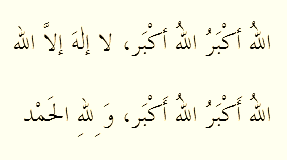
Allâh is Greatest, Allâh is Greatest, none deserves worship but Allâh. Allâh is Greatest, Allâh is Greatest, and to Him is all praise.
Ibn Abî Shaybah, Al-Musannaf Vol.2 p74. Shaykh Al-Albânî said its chain of narration is Sahîh.‘Alî – Allâh be pleased with him – used to say the takbîr following the Fajr prayer on the Day of ‘Arafah until the ‘Asr prayer of the last day of Tashrîq – he used to say it after ‘Asr prayer (then stop).
Ibn Abî Shaybah, Al-Musannaf Vol.2 p72. Shaykh Al-Albânî said its chain of narration is good.
See Irwâ Al-Ghalîl Vol.3 p125.
Tuesday, August 25, 2015
14 Instances in Which it is Disliked to Give the Salaam – By Shaikh Al-Fawzaan
14 Instances in Which it is Disliked to Give the Salaam – By Shaikh Al-Fawzaan
الحمد لله وحده، والصلاة والسلام على من لا نبي بعده، وعلى آله وصحبه، أما بعد
Shaikh Saalih bin Fawzaan Al-Fawzaan (hafidhahullaah) said during his explanation of the text of Mandhoomah Al-Adaab:
“These are the instances in which giving the salaam is disliked:
The first instance: it is disliked to give salaam to the one who is speaking, since he is busy in conversation with other than himself.
The second instance: ‘with regards to the one who is busy with dhikr (remembrance of Allaah)’ – by way oftasbeeh (saying: subhaanallaah) and tahleel (saying: laa ilaaha illallaah) and in the recital of the Qur’aan.
The third instance: with regards to the one who is pre-occupied with the hadeeth from the sayings of Muhammad (sallallaahu ‘alaihi wa sallam).
The fourth instance: giving salaam to the khateeb except during the Friday sermon; since it is forbidden to speak during the Friday sermon; and so giving salaam to the khateeb and to those in attendance is impermissible.
The fifth instance: ‘the one delivering a lecture’ – the one who is delivering a lesson relating to the Qur’aan or relating to hadeeth or Fiqh or in grammar – do not give salaam to him. Some people; when they come to a gathering and the lesson is in progress; he will give the salaam and raise his voice, this is disliked because this distracts the teacher just as it distracts those who are sat listening and so they turn their attention to him.
The sixth instance: ‘those who are researching in the sciences’ – whoever is researching an issue from the issues of knowledge then do not extend the salaam towards him and thus disrupt his research; this is not legislated.
The seventh instance: ‘one who is delivering an admonition’ – whoever is admonishing the people; then do not give the salaam if you approach, rather sit and listen to the admonition. Do not extend the salaam; because you will distract the admonisher as well as distract those that are listening.
The eighth instance: the one who is reiterating/revising in (an issue of) Fiqh; and he is the one who is revising/studying Fiqh.
The ninth instance: the muadhin; if he is giving the adhaan then do not extend the salaam towards him whilst he is giving the adhaan; since you will interrupt him from the adhaan.
The tenth instance: ‘the one who is praying’ – if you arrive and someone is praying; do not extend the salaam towards him until he has concluded his prayer. It has been reported that one of the companions gave the Prophet (sallallaahu ‘alaihi wa sallam) the salaam whilst he was in prayer and so he responded to him with an ishaarah (indication).[1] Therefore is someone gives you salaam whilst you are praying then you should respond to him with an ishaarah.
The eleventh instance: ‘the one who is observing purification’ – the one who is performing the wudhu then do not extend the salaam towards him until he has concluded his wudhu. As for the one who is bathing for other than the purpose of worship; in order to keep cool or to clean himself then there is nothing preventing you from giving him salaam.
The twelfth instance: likewise it is not legislated to give the salaam to the one who is preoccupied with eating.
The thirteenth instance: ‘to the one who is defecating’ – this is more severe; and he is the one who is urinating or defecating – do not give him salaam whilst he is relieving himself. Since it is disliked for the one who is defecating or urinating that he should speak in this situation; so do not give him salaam.
The fourteenth instance: ‘the one who is fighting the enemy in a war’ – the last type is the Mujaahid who is in the instance of fighting; you should not extend salaam to the one who is fighting because he is busied from you in fighting the enemies of Allaah.”
(Taken from: Ithaaf At-Tullaab bi-Sharh Mandhoomah Al-Adaab p.219-221)
_______________________________
[1] As reported by At-Tirmidhee in: the book of prayer, chapter: what has been stated regarding the indication in the prayer (no.367).
Sunday, August 2, 2015
What's wrong with SISTERHOOD in Islam?
What's wrong with SISTERHOOD in Islam?
Sometimes, many sisters wonder where is the sisterhood in Islam because they feel lonely. I think there is a different way to look at it: what have we done to cultivate the sisterhood in Islam?
Let's take a deeper look. So, when was the last time you invited some sisters and cooked lovely dishes and ate with them? I mean, sisterhood isn't all about praying and reading books and talking about religion. You have to have both. Invite some sisters, eat and talk and then pray together in a Jama'ah. BEST THING ON EARTH.
I heard long ago that eating and praying together keep people close to each other. Could be true and Allah knows best... I didn't test it...
Next time, go out to park and enjoy a good sunny day and nature, and let the kids play and you guys, as you talk daily stuffs, talk about something useful like sharing knowledge of Islam... something simple, something that fits in the conversation, something you learned, something you want to learn, something you want to share, something you want people to help you out...
It is not hard but it does take courage... Courage to start something new and different, courage to be with new people and introduce yourself as who you are, courage to be yourself without fearing what others may think of you, it is NOT EASY. I find it very hard myself to open up sometimes, to talk about things other people may find very weird or strange or even outright negative.
And yes, as you invite and share what you have, other sisters will do the same to you, so YOU INITIATE instead of waiting to be invited to parties and gatherings and more... You open up and allow others to enter into your life... and share their lives with you...
[I can't do many things I said here, InshaaAllah, someday I will try when I have means to carry them out. InshaaAllah].
Until then, writing is a way to express and share and communicate for me... [:D]
Thursday, July 16, 2015

Friday, July 10, 2015
My Cold Shower Therapy™ TED Talk
So, this is how I started this cold shower, let's hope I can keep up. I felt so hot, so uncomfortable, so sweaty, and tired etc. I just went to the bath and took a plain cold shower unexpectedly. I just didn't care. I just wanted to feel cold. After I took the cold shower and put on my fresh clothes and was going about my normal day, I realized how LIGHT and FRESH my body felt. It is the feeling I have been searching for like ages. When was the last time I felt this good, I do not know.
I heard something about taking cold shower but I never read on it. When I realized how good I was feeling, I started reading on the cold shower. Just to boost my motivation. Let's hope I can keep up.
I took my showers in the evening. Morning shower, I have to think about it.
But it is really great to feel light. That's what I seek the most I guess these days. I just want to feel light, fresh, simple, and happy.
Subscribe to:
Posts (Atom)